

During the many times that he spotted ISKCON devotees chanting in Washington Square Park while growing up in Brooklyn, New York in the late 1960s, Jay Cen could never have imagined that one day he’d be fronting a hip-hop group espousing their teachings.
But they caught his interest. He continued to wonder what they were about when he moved to Boston as a teenager and saw them again at Boston Common. He began to hang around them more, join in the chanting, and purchase Back to Godhead magazines from them.
At home, he pasted the magazine covers on his wall. It was in the midst of the late sixties and early seventies Indian culture explosion, and so sure, this was hip. But it was more than that. Jay felt something stirring in his soul. But for years, he didn’t follow through with it.
“One of my biggest regrets is that if I had been more assertive in my teens, I could have actually met Srila Prabhupada—I could have been at 26 2nd Ave, sitting five feet away from him,” he says now. “But I guess that just wasn’t the way it was supposed to happen. Krishna had a different plan for me.”
Instead, Jay—who was the son of a popular Boston jazz DJ and always had music in his blood—threw himself into music and started a punk rock band called the Deziners with his friend Eddie Kane.
It wasn’t until many years later, in 1995, that the thought suddenly crossed Jay’s mind: “I wonder where the Hare Krishna devotees are these days?” It seemed like a random thought, but only two days later, a devotee walked into the healthfood store where he worked.

The devotee must have been taken by surprise when the moment he walked in the shop clerk suddenly yelled, “Hey!” Where have you guys been?” But he pulled himself together quickly enough and handed Jay a card inviting him to the local Boston temple. Jay visited, and one year later, he became an ISKCON devotee.
In 2006, Jay—now Jaya Madhava Dasa— was visiting his old friend Eddie, when he noticed that Eddie’s fourteen-year-old stepson Trevor had a little recording studio, and was creating beats in it.
“Hey, do you wanna make a track with me?” Trevor asked one day.
“Sure,” said Jaya Madhava.
The song that resulted, “Look to the East,” was a kind of “Eastern philosophy primer” for the yoga community. On it, Jaya Madhava delivers the messages of Krishna, Buddha, Jesus, Moses, and Gandhi.
Excited by the track, he suggested to Eddie and Trevor that they start a transcendental Hip-Hop group, and Govinda Sky was born.
Roles were assigned naturally, with Jaya Madhava singing all the choruses and writing the devotional lyrics, Trevor Buckingham—or T-Buck—producing and rapping, and his dad Eddie adding an element generally unheard of in hip-hop—guitar solos.
“They were completely open-minded to my Krishna-focused lyrics,” Jaya Madhava says. “It was something new to them, but they loved it. And they were learning, too—especially Trevor, who was 14 when we started and is now nearly 18. He learned so much about Vaishnavism and Hinduism that he was even getting As on tests about other religions in school!”
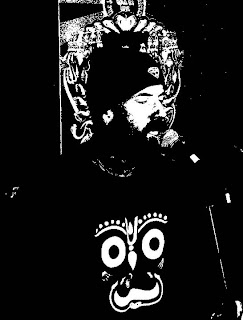 Govinda Sky spent a lot of time carefully fashioning their songs—Jaya Madhava is a perfectionist—and it took a year for them to amass enough for their first album. But at last Surrender was released independently in November 2007, through Itunes and Amazon.com.
“We’re the rare Vaishnava act in what’s called positive hip-hop, a genre dominated by Christian groups,” Jaya Madhava says. “Our message is a spiritual one, very different from what you usually hear in commercial hip-hop music—and you won’t find any bad language, misogyny, or gun sound effects on our album!”
Govinda Sky feel some fraternity with the “Krishnacore” bands of the 1990s, such as Shelter and 108, and consider themselves something of a hip-hop straightedge band. “We’re especially reaching out to the young people, our future leaders,” says Jaya Madhava. “In our humble way, we’re trying to steer them away from the materialism that 99% of the hip-hop generation is bent on.”
Govinda Sky has received a lot of positive response for their album Surrender, especially from the yoga community.
The group perform to small audiences of about thirty people at yoga studios around the Boston area. Their shows start off with a traditional kirtan, which, like the band, are a family affair—Chatamayi Dasi, a disciple of Bhakti Tirtha Swami whose son Cole Chadwick has recently become Govinda Sky’s new live drummer, plays the harmonium. Her husband Bhakta Rick plays the mridanga, Jaya Madhava sings, Eddie plays guitar, and Cole plays the African drum.
“Then we go into our hip-hop songs. We try to bring some real positive Vedic energy,” Jaya Madhava says. “A lot of our choruses are in Sanskrit, and sometimes we’ll pass out the words so that people can chant along to them. And unlike 99% of hip-hop groups, we don’t just use a playback CD—we also usually have live mridanga and tabla, kartals, guitar, and now a full drum kit. So that sets us apart from other acts and brings more energy to our set.”
 After the shows, many people approach Govinda Sky to ask, ‘Hey, where’s the nearest temple?’ And many are seen at the next Sunday Feast at ISKCON Boston. “We don’t do anything in a heavy-handed way,” Jaya Madhava says. “We just present our Krishna conscious music, and if people like it, they’ll follow through by searching out the nearest temple or listening to other kirtan bands.”
Govinda Sky are also popular at ISKCON festivals, such as last year’s Boston Ratha Yatra festival, with African ISKCON sannyasi Bhakti Vasudeva Swami saying he was “So happy to see that someone was making this kind of Krishna conscious urban music.”
With MC T-Buck busy performing with reggae group Dead Fish, and the rest of the band having a hectic summer, it’s taken Govinda Sky a while to get around to their second album. But they have recently lined up six tracks—with more on the way—and are due to start recording in the fall.
“The new album will be called Into the Ether,” Jaya Madhava says. “The title track is subtitled ‘The Story of Mirabai,’ and is about the female saint who devoted her life to Krishna. Hari Om She Said is about leaving a life of Maya, or illusion, and trying to find yourself. Dance Shiva Dance is a great dance number about the Lord of destruction.”
The album will also feature Gauranga-ji, Jagannath Poetry Slam, and Gita, which has in-depth lyrics about the famous sacred book and its modern teacher, Srila Prabhupada. “Prabhupada is such an inspiration to me,” Jaya Madhava says. “I’ve become a student of him through his books, and have also read the entire Prabhupada Lilamrita and all the other books about his life and travels. Even though I never got to meet him in person, I feel like I know him so well.”

Into the Ether will also touch on social and political subjects in tracks such as “Being Muslim is Not A Crime”—which is Jaya Madhava’s response to the religious bigotry and ‘Islamophobia’ in today’s world—and ‘Let the Animals Keep Their Coats’ an irresistibly catchy reggae track protesting the fur industry.
“Our message has always been one of tolerance—tolerance of all people, all races, all religions,” Jaya Madhava says. “That, delivered along with Krishna consciousness and the Holy Name, is our main goal.”
Govinda Sky will be touring their album locally next year, with hopes to ascend a bigger stage in the future. “People are always asking us, ‘When are you coming to Australia? When are you coming to Mexico?’ and we’d love to,” Jaya Madhava says. “But we just don’t have the capital.”
“We’re not in this for the money, we’re in this to spread spirituality,” he clarifies, but admits: “But if some travel expenses were covered and we had better management than just me, we might be able to do it more.”
He grins. “It’s just so much fun to do,” he says. “It’s a labor of love.”
From: http://news.iskcon.org/node/3138/2010-09-24/govinda_sky_breaking_the_hip_hop_mold#ixzz18XZ6lVY9
But they caught his interest. He continued to wonder what they were about when he moved to Boston as a teenager and saw them again at Boston Common. He began to hang around them more, join in the chanting, and purchase Back to Godhead magazines from them.
At home, he pasted the magazine covers on his wall. It was in the midst of the late sixties and early seventies Indian culture explosion, and so sure, this was hip. But it was more than that. Jay felt something stirring in his soul. But for years, he didn’t follow through with it.
“One of my biggest regrets is that if I had been more assertive in my teens, I could have actually met Srila Prabhupada—I could have been at 26 2nd Ave, sitting five feet away from him,” he says now. “But I guess that just wasn’t the way it was supposed to happen. Krishna had a different plan for me.”
Instead, Jay—who was the son of a popular Boston jazz DJ and always had music in his blood—threw himself into music and started a punk rock band called the Deziners with his friend Eddie Kane.
It wasn’t until many years later, in 1995, that the thought suddenly crossed Jay’s mind: “I wonder where the Hare Krishna devotees are these days?” It seemed like a random thought, but only two days later, a devotee walked into the healthfood store where he worked.

The devotee must have been taken by surprise when the moment he walked in the shop clerk suddenly yelled, “Hey!” Where have you guys been?” But he pulled himself together quickly enough and handed Jay a card inviting him to the local Boston temple. Jay visited, and one year later, he became an ISKCON devotee.
In 2006, Jay—now Jaya Madhava Dasa— was visiting his old friend Eddie, when he noticed that Eddie’s fourteen-year-old stepson Trevor had a little recording studio, and was creating beats in it.
“Hey, do you wanna make a track with me?” Trevor asked one day.
“Sure,” said Jaya Madhava.
The song that resulted, “Look to the East,” was a kind of “Eastern philosophy primer” for the yoga community. On it, Jaya Madhava delivers the messages of Krishna, Buddha, Jesus, Moses, and Gandhi.
Excited by the track, he suggested to Eddie and Trevor that they start a transcendental Hip-Hop group, and Govinda Sky was born.
Roles were assigned naturally, with Jaya Madhava singing all the choruses and writing the devotional lyrics, Trevor Buckingham—or T-Buck—producing and rapping, and his dad Eddie adding an element generally unheard of in hip-hop—guitar solos.
“They were completely open-minded to my Krishna-focused lyrics,” Jaya Madhava says. “It was something new to them, but they loved it. And they were learning, too—especially Trevor, who was 14 when we started and is now nearly 18. He learned so much about Vaishnavism and Hinduism that he was even getting As on tests about other religions in school!”

“We’re the rare Vaishnava act in what’s called positive hip-hop, a genre dominated by Christian groups,” Jaya Madhava says. “Our message is a spiritual one, very different from what you usually hear in commercial hip-hop music—and you won’t find any bad language, misogyny, or gun sound effects on our album!”
Govinda Sky feel some fraternity with the “Krishnacore” bands of the 1990s, such as Shelter and 108, and consider themselves something of a hip-hop straightedge band. “We’re especially reaching out to the young people, our future leaders,” says Jaya Madhava. “In our humble way, we’re trying to steer them away from the materialism that 99% of the hip-hop generation is bent on.”
Govinda Sky has received a lot of positive response for their album Surrender, especially from the yoga community.
The group perform to small audiences of about thirty people at yoga studios around the Boston area. Their shows start off with a traditional kirtan, which, like the band, are a family affair—Chatamayi Dasi, a disciple of Bhakti Tirtha Swami whose son Cole Chadwick has recently become Govinda Sky’s new live drummer, plays the harmonium. Her husband Bhakta Rick plays the mridanga, Jaya Madhava sings, Eddie plays guitar, and Cole plays the African drum.
“Then we go into our hip-hop songs. We try to bring some real positive Vedic energy,” Jaya Madhava says. “A lot of our choruses are in Sanskrit, and sometimes we’ll pass out the words so that people can chant along to them. And unlike 99% of hip-hop groups, we don’t just use a playback CD—we also usually have live mridanga and tabla, kartals, guitar, and now a full drum kit. So that sets us apart from other acts and brings more energy to our set.”

Govinda Sky are also popular at ISKCON festivals, such as last year’s Boston Ratha Yatra festival, with African ISKCON sannyasi Bhakti Vasudeva Swami saying he was “So happy to see that someone was making this kind of Krishna conscious urban music.”
With MC T-Buck busy performing with reggae group Dead Fish, and the rest of the band having a hectic summer, it’s taken Govinda Sky a while to get around to their second album. But they have recently lined up six tracks—with more on the way—and are due to start recording in the fall.
“The new album will be called Into the Ether,” Jaya Madhava says. “The title track is subtitled ‘The Story of Mirabai,’ and is about the female saint who devoted her life to Krishna. Hari Om She Said is about leaving a life of Maya, or illusion, and trying to find yourself. Dance Shiva Dance is a great dance number about the Lord of destruction.”
The album will also feature Gauranga-ji, Jagannath Poetry Slam, and Gita, which has in-depth lyrics about the famous sacred book and its modern teacher, Srila Prabhupada. “Prabhupada is such an inspiration to me,” Jaya Madhava says. “I’ve become a student of him through his books, and have also read the entire Prabhupada Lilamrita and all the other books about his life and travels. Even though I never got to meet him in person, I feel like I know him so well.”

Into the Ether will also touch on social and political subjects in tracks such as “Being Muslim is Not A Crime”—which is Jaya Madhava’s response to the religious bigotry and ‘Islamophobia’ in today’s world—and ‘Let the Animals Keep Their Coats’ an irresistibly catchy reggae track protesting the fur industry.
“Our message has always been one of tolerance—tolerance of all people, all races, all religions,” Jaya Madhava says. “That, delivered along with Krishna consciousness and the Holy Name, is our main goal.”
Govinda Sky will be touring their album locally next year, with hopes to ascend a bigger stage in the future. “People are always asking us, ‘When are you coming to Australia? When are you coming to Mexico?’ and we’d love to,” Jaya Madhava says. “But we just don’t have the capital.”
“We’re not in this for the money, we’re in this to spread spirituality,” he clarifies, but admits: “But if some travel expenses were covered and we had better management than just me, we might be able to do it more.”
He grins. “It’s just so much fun to do,” he says. “It’s a labor of love.”
From: http://news.iskcon.org/node/3138/2010-09-24/govinda_sky_breaking_the_hip_hop_mold#ixzz18XZ6lVY9


